Net metering has completely changed the way homeowners and businesses use electricity in Pakistan. In the regions covered by FESCO (Faisalabad Electric Supply Company), thousands of customers have already shifted to solar energy. But here’s the interesting part: most of the savings don’t come from solar panels alone. They come from FESCO Net Metering, a system that allows you to sell your extra solar units back to the grid.
If you are planning to install solar panels, or you already have a system and want to understand how net metering works in 2026, this guide is your complete, easy-to-understand resource. We will cover everything: requirements, documentation, step-by-step process, fees, benefits, real-life examples, and answers to questions most people don’t even ask.
Let’s begin.
What Is FESCO Net Metering?
FESCO net metering is an electricity billing mechanism approved by NEPRA that allows consumers with a solar power system to export excess electricity to the grid. In simple words:
When your solar panels produce more energy than you use, the extra units are sent back to FESCO’s grid.
FESCO then records these exported units, subtracts them from your imported units, and you pay only for the net difference.
If you export more than you consume, FESCO pays you at the official NEPRA rate.
This turns your solar system into a long-term investment instead of just a backup solution.
Why FESCO Net Metering Has Become Essential in 2025
Electricity prices in Pakistan have increased consistently. In the last few years, the unit rate has crossed historic levels, and fuel adjustment charges have made bills unpredictable. In such a situation, solar energy alone reduces bills, but only net metering helps you achieve the following:
- Zero electricity bills
- Income from extra solar production
- Faster return on investment
- Freedom from peak-hour charges
- Protection against rising tariffs
Without net metering, your extra solar units go to waste. With net metering, every extra unit becomes a source of saving.
How FESCO Net Metering Works (Simple Explanation)
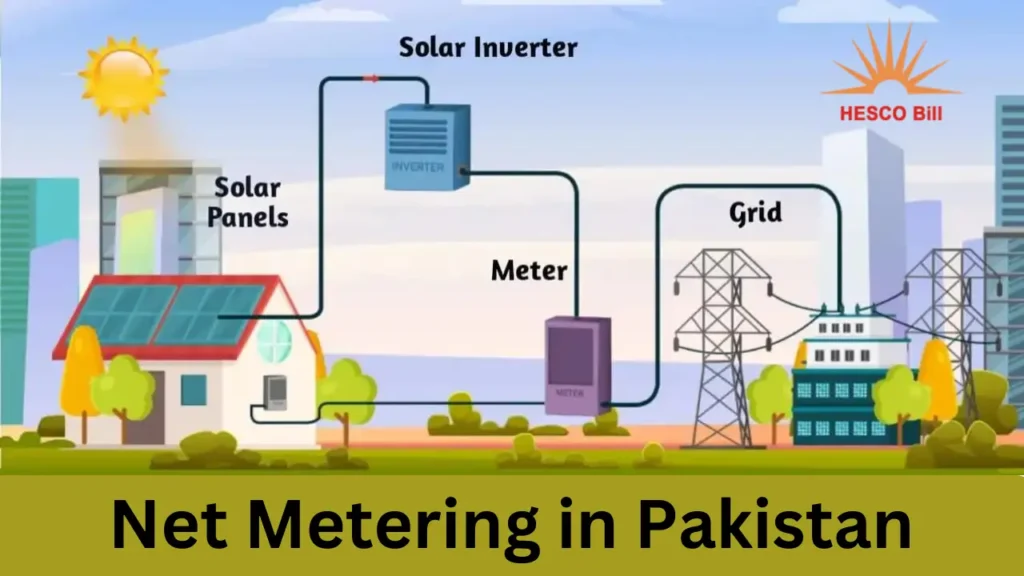
Your solar panels generate DC electricity → The inverter converts it to AC → The electricity powers your home.
When your consumption is lower than your production, your meter exports the extra units to FESCO’s grid.
FESCO installs a bidirectional meter, which records two things:
- Imported Units (IU): Units you take from FESCO
- Exported Units (EU): Units your solar exports to FESCO
Your monthly bill becomes:
Net Units = Imported Units – Exported Units
If the value is negative, FESCO pays you.
Eligibility Criteria for FESCO Net Metering
Before applying, ensure you meet NEPRA’s and FESCO’s eligibility requirements.
Basic Requirements
- You must be a FESCO consumer with a valid consumer number.
- You must own or legally occupy the property.
- The solar system must be ON-Grid (not hybrid or off-grid only).
- Inverter must be net-metering-compatible (On-Grid or Hybrid with grid-tie functionality).
System Size Limits
According to NEPRA’s regulation:
- Minimum system size: 1 kW
- Maximum for homes: 20 kW
- Maximum for commercial/industrial: 500 kW (subject to load and transformer capacity)
Approved Equipment
- Tier-1 solar panels
- Net-metering-approved inverter (Solis, Huawei, Growatt, Inverex Nitrox, etc.)
- Safety accessories: breakers, grounding, surge protection, AC/DC isolators
Required Documents for FESCO Net Metering Application
You must submit these documents through a solar company registered with AEDB (Alternative Energy Development Board):
- Copy of CNIC
- Latest electricity bill
- Property ownership document (Registry, allotment letter, or affidavit)
- Application form for net metering
- Single Line Diagram (SLD)
- System inspection report
- Inverter test reports
- Certificate of compliance (COC)
Step-by-Step Process of FESCO Net Metering in 2025
Here is the latest and most accurate process, based on NEPRA and FESCO updates for 2025.
Step 1: Site Assessment & Quotation
A registered solar installer surveys your home, calculates sun exposure, roof direction, electricity usage, and recommends the correct solar system size.
Good companies often check your past 12 months’ bills to understand your actual load patterns.
Step 2: System Installation
Your solar company installs:
- Solar panels
- Mounting structure
- On-grid inverter
- DC and AC wiring
- Breakers and safety equipment
- Earthing system
The installation must meet AEDB guidelines to qualify for net metering.
Step 3: Documentation Submission
Your installer submits all required documents to FESCO and files the application for NOC (No Objection Certificate).
FESCO verifies:
- System size
- Connection load
- Safety compliance
- Inverter certification
Step 4: Inspection by FESCO
FESCO representatives visit the site for:
- Safety check
- Wiring inspection
- Inverter performance
- Export-limit settings
- Compliance with NEPRA’s Distributed Generation Standards
If everything is correct, inspection approval is granted.
Step 5: Signing of DG Contract
FESCO asks the consumer to sign a Distributed Generation (DG) contract. This agreement legally allows you to export electricity to the grid.
The contract is valid for 7 years and renewable.
Step 6: Bidirectional Meter Installation
FESCO replaces your old meter with a new bidirectional net meter.
This meter records both import and export units accurately.
Step 7: Activation & First Billing Cycle
Once activated, your solar system officially becomes a “mini power station,” and your exported units begin reducing your monthly bill automatically.
Net Metering Charges & Fees (Updated For 2025)
Below is a general cost breakdown that applies to most FESCO regions:
- Application fee: Rs. 1,000 to 2,000
- Meter replacement fee: Rs. 25,000 to 40,000 (depending on meter type)
- Documentation & engineering fee (charged by solar companies): varies
- No NEPRA fee for domestic systems
FESCO Net Metering Unit Rate 2026
NEPRA revises net metering rates annually. As of 2025:
- FESCO pays approximately Rs. 21 to 23 per kWh for exported units.
- You are charged the standard consumer tariff for imported units.
This means every extra solar unit you export becomes a significant saving or income source.
Real-Life Example: How Net Metering Reduces Bills
Imagine you have a 10 kW solar system.
Monthly Example:
- Imported Units from FESCO: 350
- Exported Units to FESCO: 420
Net Units = 350 – 420 = –70
You exported 70 extra units.
FESCO will pay you for these 70 units at the rate of around Rs. 22 per unit.
That means:
70 units × Rs. 22 = Rs. 1,540 earned
Your bill becomes zero and you still get credit.
Benefits of FESCO Net Metering
1. Zero or Near-Zero Electricity Bills
Most homeowners eliminate 90 to 100 percent of their bill.
2. Earnings from Excess Units
If your system produces more than your usage, FESCO pays you through bill adjustment.
3. Faster Payback Period
Net metering reduces payback time from 6 years to 3-4 years.
4. Protection Against Tariff Hikes
As prices rise, your solar savings rise automatically.
5. No Batteries Needed
On-grid systems save battery costs.
6. Environmental Impact
One 10 kW system reduces almost 13 tons of CO₂ annually.
Common Myths About FESCO Net Metering
Myth 1: Net Metering Works During Load Shedding
Reality: It shuts off for safety unless you have a hybrid inverter with backup batteries.
Myth 2: FESCO Buys Unlimited Units
Reality: Export is capped based on system size and contract terms.
Myth 3: Net Metering Application Takes Months
Reality: If documents are correct, activation usually takes 30–45 days.
How Much Solar System Size Do You Need for Your Home?
Below is a practical breakdown:
| Monthly Bill | Suggested Solar Size | Expected Savings |
|---|---|---|
| Rs. 10,000 | 3 kW | 70% – 100% |
| Rs. 20,000 | 5 kW | 80% – 100% |
| Rs. 30,000 | 7–8 kW | 90% – 100% |
| Rs. 50,000 | 10 kW | 90% – 100% |
| Rs. 80,000 | 15 kW | 90% – 100% |
LSI Keywords to Enhance Your SEO
These keywords are naturally integrated into the article but feel free to reinforce them in your meta tags:
- FESCO net metering process
- Net metering Pakistan 2025
- Solar net metering FESCO
- Net metering charges
- FESCO net meter installation
- Solar system approval NEPRA
- Bidirectional meter FESCO
- How to apply for net metering
- Solar energy savings
- NEPRA DG regulations
Frequently Asked Questions (FAQ) About FESCO Net Metering
1. How long does the net metering approval take?
Typically 30 to 45 days if all documents are complete.
2. Does FESCO pay for extra units?
Yes, FESCO pays the NEPRA-approved rate for exported units.
3. Can I apply without a solar company?
No. Only AEDB-certified installers can apply.
4. Do I need batteries?
Not required unless you want backup during load shedding.
5. What if electricity rates fall in future?
Even then, net metering still remains profitable because you export during peak sun hours.
Conclusion: Is FESCO Net Metering Worth It in 2026?
Absolutely yes. With rising electricity costs, unpredictable bills, and increasing demand for clean energy, net metering is no longer just an option — it’s a necessity. It helps homeowners reduce their bills to zero, earn from extra production, and achieve long-term financial stability.